
For parents and carers in England
You look after your child.
We will keep track of the deadlines.
The EHCP process is full of legal deadlines, and nobody hands you the list. Enter the dates from your council letters and see every deadline in your case: what is due, when, and what to do if something is late. The law is cited on every line, so you never have to take our word for it.
Check your deadlines, freeTakes under a minute. No signup. Your dates never leave your device.
Your case, clearly set out
This is what you get: every deadline that applies to your case, its legal basis, and its status today. See how it works or browse everything Case Manager includes.
Final EHC plan issued
Reg 13(2), SEND Regulations 2014
Due 22 July 2026
16 days over. BreachedYour appeal window
Tribunal Rules, r.20(1)(c)
Closes 4 September 2026
28 days left. Act soonAnnual review due
Children and Families Act 2014, s.44(1)
By 10 March 2027
On trackHow it works
Tell us where you are
Pick your stage, from first request to annual review, and enter the dates from your letters.
See your case ledger
Every deadline that applies, computed from the regulations, including the exceptions councils rely on.
Know your next step
Save the dates to your calendar. If the council has missed a deadline, we show you the next step and the letter to send.
Why parents can trust this
Cited to the regulation
Every deadline carries its regulation number. Quote it in your next email to the council.
Private by design
The checker runs in your browser. Your child's dates are never sent to us or anyone else.
Honest about exceptions
Four narrow grounds can lawfully pause some clocks. The checker applies them, so you can tell a lawful delay from a breach.
Alongside the charities
IPSEA and SENDIASS give brilliant free advice. We handle the dates and paperwork so you can use their advice well.
If this feels hard, it is not just you
718,838
children and young people in England have an EHC plan
DfE, January 2026
46.1%
of new plans were issued inside the legal 20 week limit
DfE, 2025, excluding lawful exceptions
26.6%
of requests for an assessment were refused first time
DfE, 2025
95–99%
of decided Tribunal appeals go the parent's way
HMCTS data, 2023–25
Delays and refusals happen to thousands of families every year. They are not your fault. When parents appeal, the vast majority succeed, and knowing your deadlines is where that starts. See the full success rate data or how your own council performs.
Guides that answer the question you actually have
How to apply for an EHCP
Who can ask, what to write, the evidence that matters, and every deadline from request to final plan.
Refused? What to do next
A quarter of requests are refused first time. Your rights, your deadline, and the next step to take.
The 20 week deadline
What the law requires, the four narrow exceptions, and what councils get wrong about them.
Council missed a deadline
The escalation ladder that gets results: chase, complain, Ombudsman, and when to mention judicial review.
Sections A to K explained
Which sections carry legal weight, and the exact wording tests that make provision enforceable.
Appeals and the Tribunal
What you can appeal, the mediation step, the deadlines, and what the process really involves.
All guides · Free letter templates · Not sure if your child qualifies? Check in two minutes
When you are ready, there is more help here
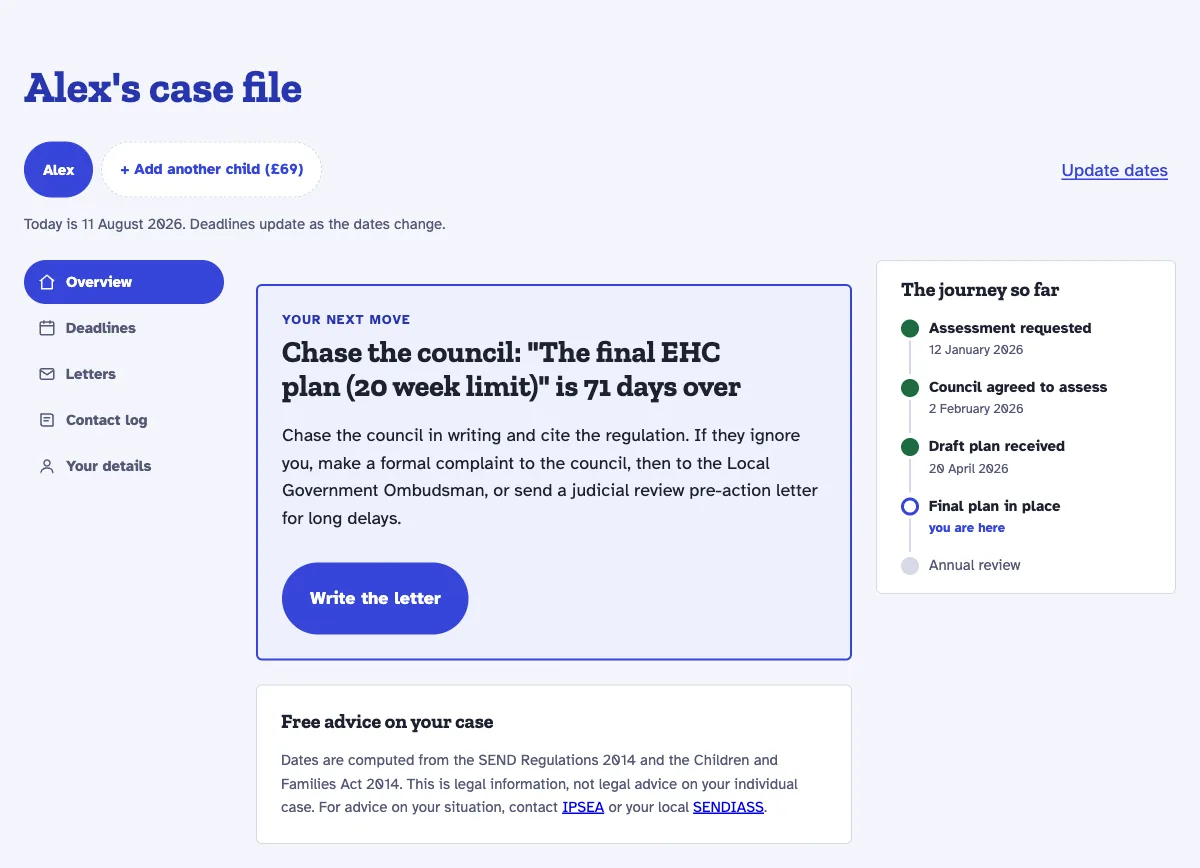
The free checker is the start. Case Manager keeps your whole case in one place: every deadline tracked with a reminder email before each one, letters matched to your exact stage and dates, and a plain answer to the question that matters, which is what to do next. It costs £29 a month, covers up to four children, and you can cancel from your account at any time. See how it works.
Common questions
Is the deadline checker really free?
Yes. The checker is free, needs no signup, and runs entirely on your device. Case Manager is the paid part, for families who want help with the whole case.
Where do the deadlines come from?
From the law: the Children and Families Act 2014, the SEND Regulations 2014 and the SEND Code of Practice 2015. Every deadline we show carries its exact regulation reference so you can quote it to the council.
My council says the 20-week deadline does not apply. Can that be true?
Sometimes. The regulations allow four narrow exceptions, for example a school closed for at least four weeks over the summer. The checker knows the exceptions and will not call something a breach when an exception genuinely applies.
Does this cover Scotland, Wales or Northern Ireland?
No. EHC plans are England-only law. Scotland uses Co-ordinated Support Plans (see Enquire), Wales uses Individual Development Plans (see SNAP Cymru), and Northern Ireland uses Statements.
Not sure where to start? Ask us.
If something on this site is unclear, or you want to know whether Case Manager would help in your situation, send a message. A person reads every one and replies within 2 working days.
We cannot advise on individual cases. For that, IPSEA and your local SENDIASS give free, independent advice.